12 May 2016

Intelligence, Courage and Love

I believe I've landed a dream job: teaching visual arts at the Arts Commons through Campus Calgary Open Minds and the One-Day Arts School program.  

The students teach me a lot.  Mostly they teach me about being really open-minded as they are generally not bound by pre-conceived ideas of structure and meaning in their projects.  It's very refreshing.

This month I taught two mask-making workshops with grade 4-5 students, with a concept based on this poem.  My idea for the project was to think about identity in terms of intelligence, courage and love.  If we have these three things - and most of us do, if we look deeply enough - then we are rich, no?  Intelligence, courage and love are things that no one can take away from us, because they come from inside ourselves - and we can use them to overcome life's pain and celebrate beauty.

First I will show you some prototypes I made, and then the students' work.

verna vogel mask prototypes, papier-mache and cardboard masks
Mask prototypes: papier-mache and shaped cardboard
For every new art process, I make prototypes in my studio.  Doing this ensures the feasibility of the project within the time frame and - perhaps more important - creates a kind of mental space for me to think about how the project integrates with the students' curriculum, how I can introduce the concept, et cetera.  I do my best thinking with my hands.


The first workshop was through Campus Calgary and we had two days, which meant we could do papier mache!  Below are my prototypes for complex and simple mask designs:

verna vogel papier-mache maskverna vogel mask-making class


verna vogel papier-mache masksverna vogel mask-making workshop

The second workshop was through One-Day Arts School, so we used templates to make shaped cardboard masks.  Starting with a simple template, these masks can become more complex by extending the shapes.

verna vogel mask prototypes
Shaped cardboard templates and masks


So those were my own studio prototypes.  Below are some masks the students made, and they did some pretty sophisticated work.  Both classes were super creative and came up with whole new concepts of how one can make a mask.  I learned a lot from them!

Papier-mache masks:

Half & half face, 3D bird beak and wings, wild pink feathers,
abstract triangular appendage - so much imagination!


Shaped cardboard masks:

See the yellow mask at the left?  That's hockey net on top!
There were so many excellent variations on my simple template.


Some of the students' comments and descriptions of their masks:

The different colours symbolize different aspects of my personality, such as my helpfulness (love), my sense of humour (intelligence), and my patience (courage).

The silver colour and Viking shape of my mask is for courage, the red gem in the middle is for love and the amber gems are my intelligence.

I used paint splatters which look like MRI images of areas of the brain which light up when engaged.  Also, the blue-green colour is like a peacock, which is a very intelligent bird.

My mask is overall red and has sparkly gems all over it, because intelligence, courage and love are inseparable.


I feel grateful to be able to engage in this level of creative thinking, to contribute to the creative learning of future generations.  It seems a very worthwhile use of my talents.  A quote from the Arts Commons website:

"Uncovering curriculum through the lens of the arts has the potential of engaging our youth, equipping them with the skills and knowledge that will help them respond to the complexities of our world today and in the future."

Yes indeed.

24 April 2016

observation

As an artist I like to cultivate a habit of visual observation by painting landscapes and making portraits.  Not that I try to reproduce anything exactly, as that would quickly get boring.  Rather, it's a case of split-second, on-the-spot extrapolation, made possible by many years of focussed observation.

For example, at a glance the view below is rather mundane:


But when I take the time to closely observe what is happening in the landscape, I can pull out some of the pure colours which make up all those tertiary tones, and, taking a few compositional liberties as well, arrive here:

steel sky woman

What fun, eh?


Besides going plein air painting, this week I made a few more quick portraits.  The basic drawing part generally takes about 10 minutes; add a few more minutes for colour.

vernavogel

In making portraits, the most important thing for me is to catch the feeling of the person.  This requires perhaps a deeper level of observation than mere representational accuracy.

verna vogel

Sometimes I catch the feeling; other times, not so much.  

verna vogel

On rare occasions, the universe conspires in our favour and the portrait not only catches the feeling of the person but is also quite representationally accurate!

verna vogel

There are so many subtle things to observe about people, and the mood of the artist has some effect as well.

verna vogel

For me it not possible to catch much feeling from a photograph, so all my portraits are done "live".

verna vogel

Those portraits above are all done in my red 9x12 sketchbook, with half-perished Sharpie marker and watercolour crayons.  Sometimes I apply a coat of gesso and other times I just work on the paper as is.  The gesso is a nice base for watercolour crayons, and affects the line quality of felt markers, too.

Besides applying my observational skills to landscapes and portraits this week, I have also been suddenly teaching quite a lot.

That aforementioned "split-second, on-the-spot extrapolation" has become almost effortless in my art practice.  For example, the portraits above took maybe 10 minutes each - a bit longer when I used colour - and the landscape painting took maybe an hour from start to finish.  No problem, right?

In the classroom this is not the case.  Often I feel I'm flying by the seat of my pants.  It is not effortless for me to observe and react to 20-25 children's intellectual and social capacities at various age levels, their motor control skills, individual psychology, group dynamics, and a host of other subtle qualities, all while taking them through a process that will yield an appreciable end result.  Add to this mix the need for lickety-split mental reflexes and a very different approach to time management, and the whole thing becomes quite an adventure!

In fact it's rather like the way my art practice felt back in my student days.

Hehee.  It's good to be a student again.

14 April 2016

reading and writing

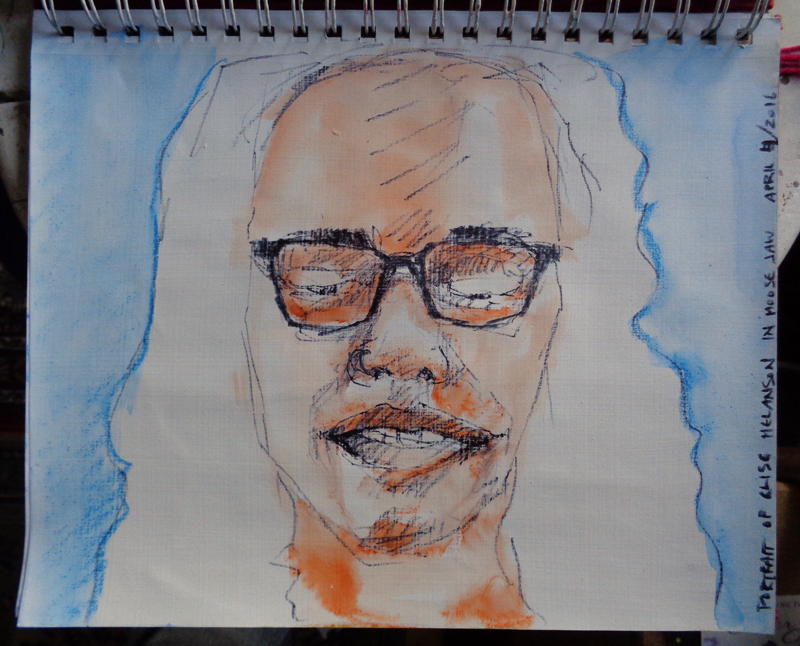
Portraits I made over the last few weeks, friends and also some new people I met.

verna vogel portrait

portrait of Elise Melanson

verna vogel portrait

portrait of Tara Gish

portrait of Baby June at 6 months old

verna vogel portrait

portrait of Andrew Saliken

verna vogel portrait

verna vogel portrait

portrait of Uli Osterman


 The type of art I made while travelling - quick portraits and simple landscapes - has rejuvenated me on some level.

Today I spend time reading and writing; among other things I have been immersing myself in the ideas of Oliver Sacks.  His brilliant scientific mind combined with his very humanist sensibility appeals to me, and he is able to present complex ideas and information in a very accessible way that makes for exciting reading.

portraits by verna vogel

I begin to take notes mainly in order to remember some of the details, as this is a library book which must be returned, and find that my note-taking has a secondary effect of leading to more ideas and connections in my own mind.

:)

11 April 2016

Travellin' art-makin' Lady

I've been travelling!  First out to the west coast, then east into the prairie, with a week between.

1. Before my Travels:

I prepped some grounds on Arches 140lb watercolour paper for my friend Russell Mang and I to make some collaborative works.

grounds
one side

verna vogel calgary artist
the other side


I worked a bit more on a few of the small oil paintings which have been in progress since July 2015...

small oil paintings

verna vogel calgary artist


… and made some small oil studies on primed paper, about 10x11 and 12x12 inches:

verna vogel calgary artist


2. During my Travels:

Plein air painting with Ross Melanson at Wakamow Valley in Moose Jaw, Saskatchewan.

done over Ross's old painting
inspired by Ross's painting style

a more typical-for-me landscape painting


I also hiked, made meals for & with friends, had good conversations and enjoyed the company of various pets - also made portraits of friends both East and West, which I will show you in a separate blog post later.


3. After my Travels:

The week of my return, I worked a shift at the art-supply store, taught a couple of  classes at Arts Commons, and went to the KOAC Art Centre Gala, where my painting along with many others were auctioned to raise funds for the Centre.

arts commons
many colourful prints at Arts Commons

verna vogel calgary artist

arts commons


KOAC Arts Centre
"Skyline II" oil on stitched canvas, 2012
auctioned at KOAC Fundraiser Gala


Finally, yesterday I worked in the studio all day!  Painting on stretched canvas:


homophonics
before
homophonics
after 
And small studies on paper:

before

after

and a couple of new studies begun

With only a week between the two trips, it felt like a lot of moving around for this artist who is usually quite grounded in one place.  But returning from my travels I feel quite rejuvenated!


30 March 2016

red sketchbook

I recently went to visit a friend for a few days, and brought along my red sketchbook, a couple of Sharpies and a set of watercolour crayons.

My friend is understandably a bit shy about portraits of her & family so I won't post those, but here's a landscape I did from the window of their guest room:

the red sketchbook
under drawing with Sharpie marker

gone over with watercolour crayons

Then, on my way back home, I was able to meet up with someone whom I'd only ever known through social media.  This was very interesting, a first for me!

Uli and I hit it off right away and had a few hours of great conversation and a lovely meal at her home, before I had to get on a plane.  During our brief visit I was able to see some of her paintings.  That was a real treat, as I have admired her work for some time, and the actual paintings have even more impact than the images on a screen which first impressed me. Click here to see some of Uli's work.

I also managed to make a couple of super-quick sketches of her and her husband with a perishing Sharpie.  An old partly-dried marker is a much more interesting drawing tool than a fresh marker.

Not super-accurate anatomically, but catching a little of the feeling:

Sharpie marker

the red sketchbook
Sharpie marker

I've had my red sketchbook for several years and it has slowly filled up with portraits, maybe 50+ faces painted and drawn with all sorts of materials.  

And 3 landscapes.  For variety, you know.  :)

10 March 2016

Homophonics

While thinking about my stalled studio endeavours, I made another entry into the pattern book:

pattern book


And I did a bit of searching around for ways to describe what I'm aiming for in the studio.  I've got this thing going on lately where I'm trying to make visual images about sound and movement, so I looked up words related to music in my old Webster's Dictionary and came across some interesting stuff.  

Then I consulted the Oracle (in this case Wikipedia) to expand on some of those words.  In particular I found myself liking the sound and concept of "homophony".

The sound of a word when spoken can be as important as its meaning.  

homophony


In music, homophony (/həˈmɒfəni, hoʊ-, -ˈmɒfni/; Greek: ὁμόφωνος, homóphōnos, from ὁμός, homós, "same" and φωνή, phōnē, "sound, tone") is a texture in which a primary part is supported by one or more additional strands that flesh out the harmony and often provide rhythmic contrast.

homophonics


homophonics

Homophony: Homophonics.  It's kind of an awkward-sounding word when I say it aloud, almost a tongue-twister.  Which syllable to stress?  I don't know.  But I like the word, I like its awkwardness and I like how it describes these paintings.

Yes, I think that is what I am attempting in the studio: exploring visual Homophonics.

homophonics


Tomorrow I teach a class of 26 grade-3 students how to make and print collagraphs based on their studies of Peru.  Prototypes made, panniers packed for the ride & I'm basically ready to go.

Meanwhile, "homophonics" will be settling into my mind.